
Deed Types in Marshall County Records
A deed records a transfer of land or a claimed interest in it. The label in an index matters less than the instrument and the facts behind it. Marshall County Chancery records also file mortgages, liens, lis pendens, plats, and releases. These instruments sit alongside the deed trail. So keep true transfer documents separate from encumbrances while you work.
| Deed Type | What It Does | Common Use |
|---|---|---|
| Warranty deed | Conveys land with stated title covenants | Ordinary sale or transfer |
| Special warranty deed | Limits covenants to the grantor's period or acts | Transfer with narrower assurances |
| Quitclaim deed | Conveys the interest the grantor may have | Interest cleanup or family transfer |
| Executor or administrator deed | Conveys through estate authority | Probate sale or distribution |
| Commissioner or foreclosure deed | Records a court-authorized or foreclosure transfer | Property litigation or foreclosure |
| Tax-sale conveyance | Records an interest arising from the tax process | Post-sale and redemption chain |
A deed of trust secures debt. It is not the everyday ownership transfer. Liens and lis pendens place burdens or notice on land rather than passing title. Always chase the later releases, satisfactions, final orders, and deeds. The first filing rarely tells the final story.
Marshall County Chancery Keeps Deeds
The Marshall County Chancery Clerk serves as recorder for instruments affecting land. The office also handles estates, guardianships, conservatorships, divorces, custody matters, and property disputes. Any of those cases can produce a deed or court order that belongs in an ownership chain.
Mail and counter requests work best with full detail. Give the office party names, the parcel and legal description, instrument type, an approximate filing date, and any book/page or instrument number you know. The county publishes no copy or certification fee schedule. Ask for a quote before ordering.
Marshall Deed Index Search Fields
The Deeds & Records Link offers far more than a surname box. Lean on the land fields when common names flood the results. Try party variants whenever an estate, trust, or entity enters the chain.
| Index field | Format or option | Use |
|---|---|---|
| Grantor or grantee | Last name, first name; partial-name modes | Find a transfer by party |
| Book and page | Book type, book, page, or ranges | Open a known citation |
| Filing date | Single date or date range | Narrow a transaction period |
| Section, township, range | Two displayed sequences and refinements | Find rural land descriptions |
| Subdivision and lot | Subdivision selector and lot text | Find platted property |
| Instrument number | Year-number or range | Retrieve a known filing |
| Instrument and party filters | Type; include grantors or grantees | Reduce mixed result sets |
The official query form displays those party and land controls on one screen. Sign in to confirm the exact result columns the index returns.
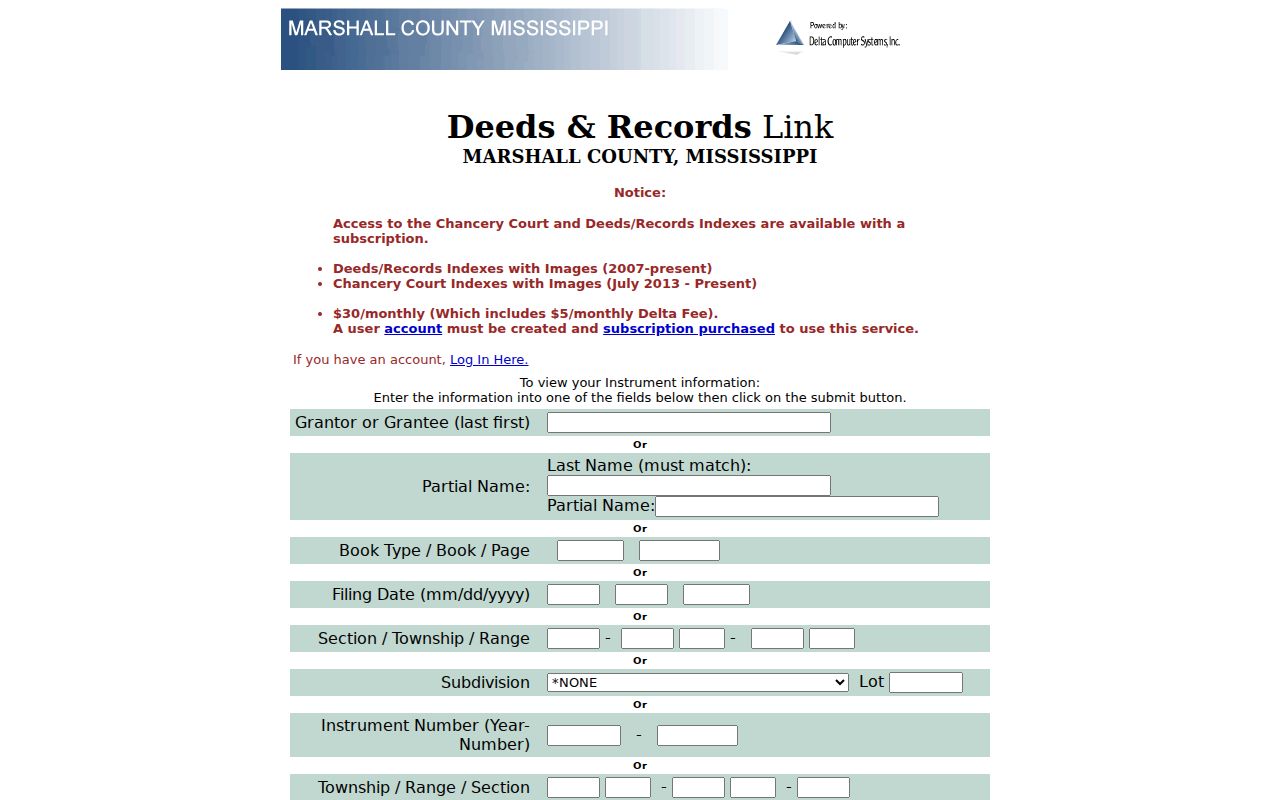
Because the form handles both party and land searches, one tract can stay in view. Surnames may change, but the land does not.
Marshall Deed Images Begin in 2007
The Delta landing page states that deed and record indexes with images run from 2007. Coverage continues to the present. Remote index and image access requires an account. It also requires a $30 monthly subscription, which includes a $5 Delta fee. The same page warns that uploads may lag courthouse activity and can contain omissions. The online version is not the official record. Read the current coverage notice before subscribing.
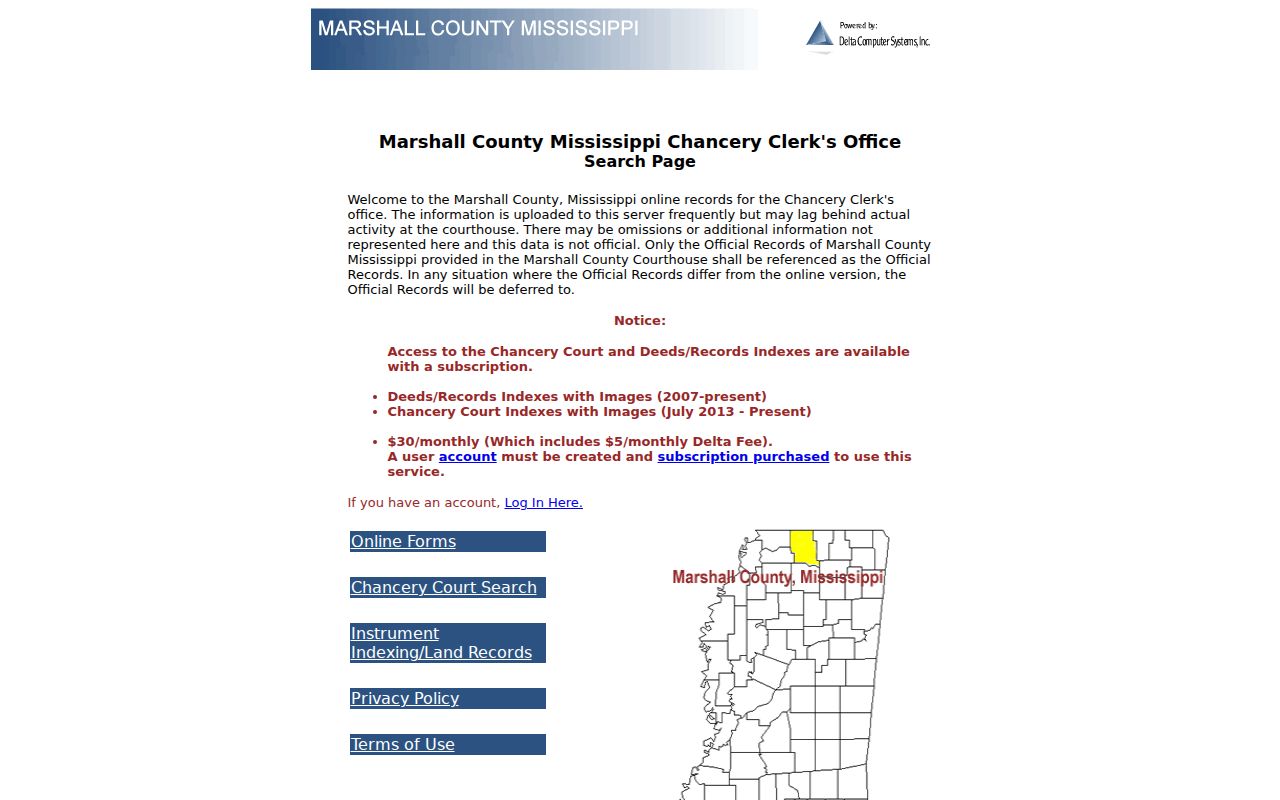
Online access saves a trip for newer instruments. The courthouse remains the route for official copies and older books.
Coverage limit. The stated online image run starts in 2007. Earlier deeds require the clerk, deed books, or archive and microfilm finding aids.
Walk Marshall County's Deed Chain
A direct index is organized around grantors. Those are the parties transferring an interest. A reverse index turns to grantees, the parties who receive it. Mississippi law requires the chancery clerk to keep alphabetical direct and reverse indexes and to make land records accessible at proper times.
- Start with the current grantee from the latest deed, not just the assessor spelling.
- Read the grantor and legal description from that instrument.
- Search that grantor as a prior grantee, keeping the description fixed.
- Record every book/page, instrument number, filing date, plat, easement, and covenant citation.
- Repeat until the web images stop, then continue in books or microfilm.
- Grantor
- The party transferring a claimed interest.
- Grantee
- The party receiving a claimed interest.
- Chain of title
- The ordered series of instruments tied to the same land.
- Book and page
- A volume-and-page citation to a recorded document.
- Instrument number
- A filing identifier, exposed in year-number form by the online index.
A street address alone is weak for this work. Use subdivision and lot, section-township-range, or the full metes-and-bounds description. That discipline keeps a same-name result from dragging the chain onto different land.
Liens Beside Marshall County Deeds
The Chancery Clerk records deeds of trust. It also records construction and condominium liens, federal tax liens, and lis pendens. Each one needs a later-status check. A deed of trust may carry an assignment, modification, release, or satisfaction. A lis pendens signals litigation but never shows who won. Search debtor, lender, claimant, and owner names together with the legal description. Then inspect the Chancery case behind any court filing.
Estate sales may call for the probate petition, order, and letters. They may also need the executor or administrator deed. A foreclosure can require the complaint, final order, sale, and later deed. Never assume a parcel is free of claims because the assessor card looks clean. The tax roll is not an encumbrance index.
Older Marshall Deeds and Microfilm
Two fallback paths run through the Mississippi Department of Archives and History. Its county-records microfilm table filters by county and reports series, contents, volume, dates, index, district, and roll number. The Media Room is self-serve. Originals may remain at the courthouse.
MDAH's Series 1202 lists Marshall County tax material from 1836 through runs in the 1890s. Series 0355 adds groups from 1916 through 1932. These are tax catalog runs, not deed books. They can place an owner on land during a gap year, but a true deed chain still needs deed indexes and instruments.
FamilySearch's Mississippi State Archives collection spans 1818 through 1952 and includes land and tax material as published. Account or image limits may apply. Search that archive only after the county and land description are firm.
The Marshall County Courthouse Caveat
Holly Springs history holds that the current courthouse rose between 1870 and 1872. The earlier courthouse burned during the Civil War. That fire alone does not prove a particular deed book was lost. It does frame the right questions for an old-chain gap. Ask whether the direct or reverse index survived. Ask whether a worn or damaged book exists. The clerk may hold a replacement volume recopied from it. Ask whether MDAH or another vendor filmed it. Tax rolls, probate files, plats, court decrees, and neighboring-owner descriptions can bridge a gap. They are substitutes, though, not the deed itself. Present them as supporting evidence, never as the missing original.
Note: Record the exact missing years and book references before asking an archive to search. "Old deeds" is too broad for an efficient request.
Plats Anchor Marshall County Deeds
A subdivision deed often trims its land description to a lot, block, subdivision name, and a recorded plat citation. Read that plat with the deed. Streets, easements, dedications, monuments, adjoining subdivisions, and approval certificates can all live there, incorporated by reference. Holly Springs rules demand final-plat precision. That means the government-survey relation, point of beginning, lot and street lines, curve data, surveyor certificate, and approvals. Byhalia shows the city-to-county handoff. Town approval and city-clerk attestation come first, then Chancery Clerk certification at a plat book and page. Covenants may cite a separate deed-record book and page.
One trap deserves mention. A preliminary planning map is not the recorded plat, so find the final filing and match its legal description to the deed.
Marshall Deed References Worth Saving
Save more than the image. Record the grantor, grantee, instrument type, filing and recording dates, book and page, instrument number, and the full legal description. Note every plat, covenant, easement, release, probate case, or court order the deed cites. Those references make the next step reproducible.
Names alone are risky. Initials, suffixes, spelling variants, fiduciary titles, and entity punctuation can shift between filings. Land descriptions give you something steady to compare. When two instruments carry similar parties but different lots or sections, keep them apart instead of forcing one chain. A blank field in an online result is not proof of missing evidence. Verify the live result labels first. Keep the source date with any printout.
Obtain a Marshall County Deed Copy
Newer deed images sit behind the paid Delta route, while courthouse or clerk viewing stays free. The clerk can also issue official or certified copies. Phone and mail requests work too. Include the names, instrument type, date range, parcel, legal description, and any known citation. Reach the Chancery Clerk at 662-252-4431 or P.O. Box 219, Holly Springs, MS 38635.
For a broad nonexempt electronic set, file a focused Mississippi Public Records Act request and name the format you prefer. The office may recover reasonable actual costs for search, review, duplication, and mailing, usually in advance. No deed-copy fee schedule is posted for Marshall County. Ask for an estimate. Say whether you want plain or certified copies.
Recorded, not guaranteed. Marshall County deed records show filed instruments. An index result is not a title opinion, and unrecorded interests or missed filings may exist.