
Read Marshall County Tax Records
Marshall County property tax records split facts in two. They divide the facts that value land from the facts that collect tax. On the appraisal side sit the owner name, situs address, mailing address, parcel or PPIN, and legal description. The same side holds the land and improvement values, true value, assessed value, class, exemptions, and tax year. The tax side carries the yearly charge, payment status, penalties, taxing districts, and any delinquent or sale flag. A situs address is simply the physical location. It may differ from the address where the bill is mailed.
| Field | What It Shows | Where |
|---|---|---|
| True value | The assessor's estimate before the class ratio | Tax Assessor appraisal record |
| Assessed value | The value produced after applying the state class ratio | Tax Assessor roll |
| Exemption status | Homestead or another approved tax adjustment | Tax Assessor record |
| Annual bill | Tax charged for the listed year | Tax Collector record |
| Payment or delinquency | Whether the charge was paid or entered the collection process | Tax Collector record |
Each figure answers a different question. Mississippi applies classification ratios to true value: Class I owner-occupied residential real property is assessed at 10 percent, most Class II real property at 15 percent, and Class III utility property at 30 percent. Millage is applied in the taxing process after that. A recorded consideration amount belongs to a past transfer. It is not the assessor's current true value or the assessed value used for tax.
Search Marshall County Tax Fields
The Delta real-property tax search offers several ways into Marshall County property tax records. Start with one field. A broad owner search can return several parcels. A parcel number or PPIN is meant to reopen one known record. Rural land may be easier to locate through its government-survey description. It may be harder to find through a modern postal address.
| Search field | Best use | Watch for |
|---|---|---|
| Owner name | Find parcels tied to a person or entity | Name order, initials, and entity spelling |
| Address | Start with a known street location | Rural routes and old highway names |
| Parcel number | Return to one exact tax parcel | Transcription errors |
| Section, township, range | Search rural acreage | Use all three legal-description parts |
| PPIN | Use the vendor property identifier | Do not confuse it with a deed instrument number |
The Delta system opens on a public search form rather than a tax-bill result. Open the official tax form to reach the live entry screen.
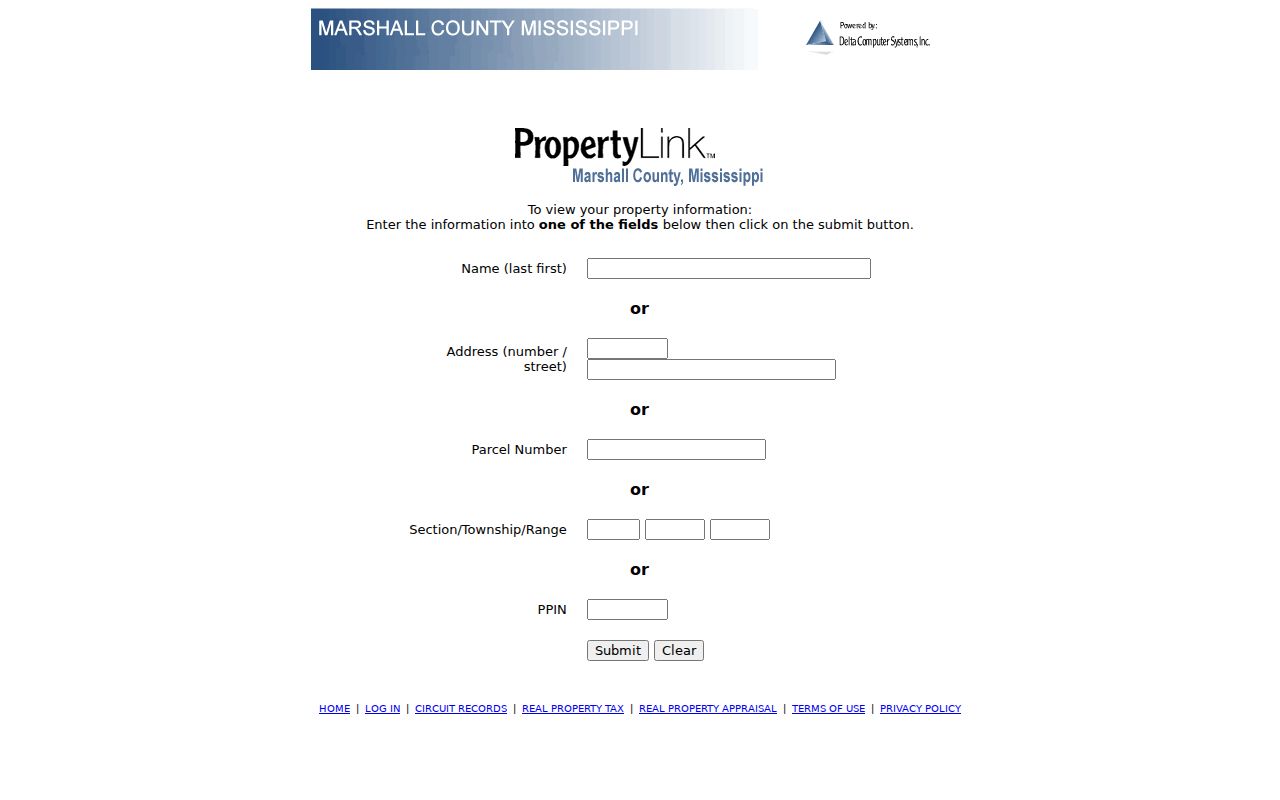
The form confirms the available search keys. Actual amounts and status must come from the returned record or the Tax Collector, not from the blank screen.
Trace a Marshall County Tax Bill
Use the tax year and parcel key together. The same street address can be styled more than one way, and an owner may hold several tracts. Marshall County property tax research is more reliable when the appraisal record and the collection record are compared instead of treated as one screen.
- Search by address, then save the parcel number and PPIN from the best match.
- Open the correct tax year and copy the charge, payment date, and current status exactly.
- Compare the Tax Assessor record for true value, assessed value, class, and exemptions.
- Ask the Tax Collector about any delinquency, sale entry, redemption, or balance that is unclear online.
- Assessed value
- The portion of true value produced by the state class ratio.
- Millage
- A tax rate applied in the property-tax calculation.
- Homestead exemption
- Approved tax relief linked to an eligible owner-occupied home.
- Tax lien
- A legal claim tied to unpaid property tax, not a deed showing ownership.
Keep screenshots or printouts with the access date. Delta warns that online uploads may lag courthouse activity, and the official record controls. The same county tax system supplies the bill-result route.
The entry form repeats until a bill is submitted. Do not treat it as proof of payment or delinquency.
Marshall County Assessment Classes
The class ratio explains why true value and assessed value are not equal. Mississippi places owner-occupied residential real property in the 10 percent class. Other real property generally falls in the 15 percent class. Utility property uses 30 percent. Classification matters before millage or an exemption affects the final amount. A homestead flag can be useful. But it is not proof of title or occupancy on the day of a search. The Mississippi Department of Revenue homestead material describes state rules. The Marshall County Tax Assessor handles the local filing. Compare the exemption with the deed, physical address, and tax year. A recent purchase may not yet be reflected on every record. Note: Record tax classification, exemption status, and ownership as separate facts for the same parcel and tax year.
Marshall County Revaluation Timing
Mississippi requires real property to be reappraised at least once every four years. That is a minimum cycle. It is not a promise that each parcel changes by the same amount or on the same date. New construction can affect a record between broad revaluation work. So can data corrections, classification changes, and local market evidence. Compare years carefully. An increased bill may result from value, class, exemption, or millage changes. It does not by itself prove a new sale. The Department of Revenue appraisal overview explains the state framework. Marshall County's roll and the supporting parcel facts remain the place to test what changed for one property.
Verify Marshall County Homestead Status
The Marshall County homestead worksheet asks for owner and spouse details, mailing and physical addresses, purchase and deed information, vehicles, and supporting documents. Those fields show why exemption review reaches beyond a single checkbox. Eligibility must be established through the assessor's process. Start with the current parcel card. Then ask the Tax Assessor what is on file for the tax year at issue. Do not infer that a blank online field proves no application was made. The office can explain whether the record is pending, disallowed, or shown elsewhere in its files. For estate or trust ownership, bring the recorded instrument. Ask how state homestead rules apply to that form of title.
Follow Marshall County Delinquent Tax
The Marshall County Tax Collector runs delinquency collection and the yearly tax sale. Mississippi rules let real-estate tax sales happen on the first Monday in April. The last Monday in August is a second sale date. The state rule fixes no date ahead of time. It also fixes no parcel list for any Marshall County sale. Ask the collector for the sale year, the parcels offered, and the bidder terms. Confirm current status before you rely on anything.
Once a sale has happened, move to the Chancery Court land records. There you can trace the tax-sale list, any redemption, a release, a conveyance, or the deed itself. A sale entry never closes the chain. Redemption or a later recorded act can still change who ends up owning the parcel. Marshall County posts no standing public delinquent-land list. Calls, office visits, and written requests still matter.
Note: Verify the tax year and confirm a past-due flag directly before any purchase or title decision.
Contest Marshall County Tax Value
Marshall County set its 2026 open-roll period from the first Monday in July. It ran to the first Monday in August. Start with the parcel facts at the Tax Assessor. Fix the address, acreage, building details, class, and any exemption evidence first. Value arguments come second. If the dispute survives that review, take it to the Board of Supervisors. That hearing is the first-Monday-in-August equalization meeting.
The county's evidence list is specific. Bring three to five comparable sales from the prior six to twelve months. Other options include proof of a factual error. Photographs, repair estimates, a market analysis, or a recent appraisal also count. Any appraisal must come from the prior twelve months. Every comparable should match the parcel's class and physical facts. A neighbor's asking price is not a closed sale or a professional appraisal.
2026 appeal window. Review the roll between the first Monday in July and the first Monday in August, then file the objection for the equalization meeting.
Check the Marshall County Tax Assessor page for the current year's schedule before you act. Dates can shift in a later tax year.
Request Marshall County Tax Files
When the portal falls short, go straight to the office that holds the record. The Tax Assessor keeps the roll, values, exemptions, and appeal material. The Tax Collector handles bills, payments, and delinquency. Supply the parcel number, PPIN, tax year, owner name, and the exact record you want. The assessor is Barbara A. Belfoure, P.O. Box 40, Holly Springs, Mississippi 38635, at 662-252-6209. The collector's listed number is 662-252-3661.
For nonexempt material, a written request can cite the Mississippi Public Records Act of 1983, Miss. Code Ann. sections 25-61-1 and following. The law allows reasonable actual-cost charges for search, review, duplication, and mailing, usually paid in advance. Response windows can run from one working day to seven with a written explanation, and no more than fourteen without agreement. Ask for an electronic copy when one exists. If anything is denied, request a written exemption citation.