
Trace Back Marshall County Former Owners
No single parcel card will hand you a full list of former owners. Reconstructing them takes a sequence of records. Read it from the newest verified deed backward through each grantor and grantee. Marshall County's online images cover only a stated modern span. Earlier ownership evidence lives elsewhere. You can turn to courthouse deed books, Mississippi Department of Archives and History microfilm, historic tax rolls, and published archive collections. Each layer adds names.
| Source | Years It Covers | Where Held | What It Shows |
|---|---|---|---|
| Delta deed images | 2007 to present | Chancery online service | Recent instruments, parties and recording references |
| Courthouse deed books | Earlier span not stated online | Marshall County Chancery Clerk | Older conveyances and legal descriptions |
| MDAH Series 1202 | 1836 into the 1890s | MDAH catalog and microfilm | Historic combined and land-tax material |
| MDAH Series 0355 | 1916 to 1932 groups | Mississippi archives | Later county record groups |
| State Archives collection | 1818 to 1952 collection span | FamilySearch | Published land, tax and related archive images |
For a transfer inside its image span, Delta is the practical tool. Earlier deeds require a different route, so ask the clerk about the book and index path. No official source publishes a complete pre-2007 online cutoff. Tax material can place a name near the land in a given year. Treat it as support for the deed chain. Never treat it as a substitute for the recorded instruments themselves.
Start Marshall County's Past-Owner Timeline in 2007
The Marshall County Chancery records landing page states that deed and record images are online from 2007. Coverage runs to the present. Access requires an account and a $30 monthly subscription, which includes a $5 Delta fee. The service warns that its data can lag courthouse activity, and official records control. The grantor-grantee search form displays the party, land, and instrument choices. A backward trace depends on them. It shows no submitted result. So never infer a party, price, or book reference from the form alone. Work from the deed image itself.
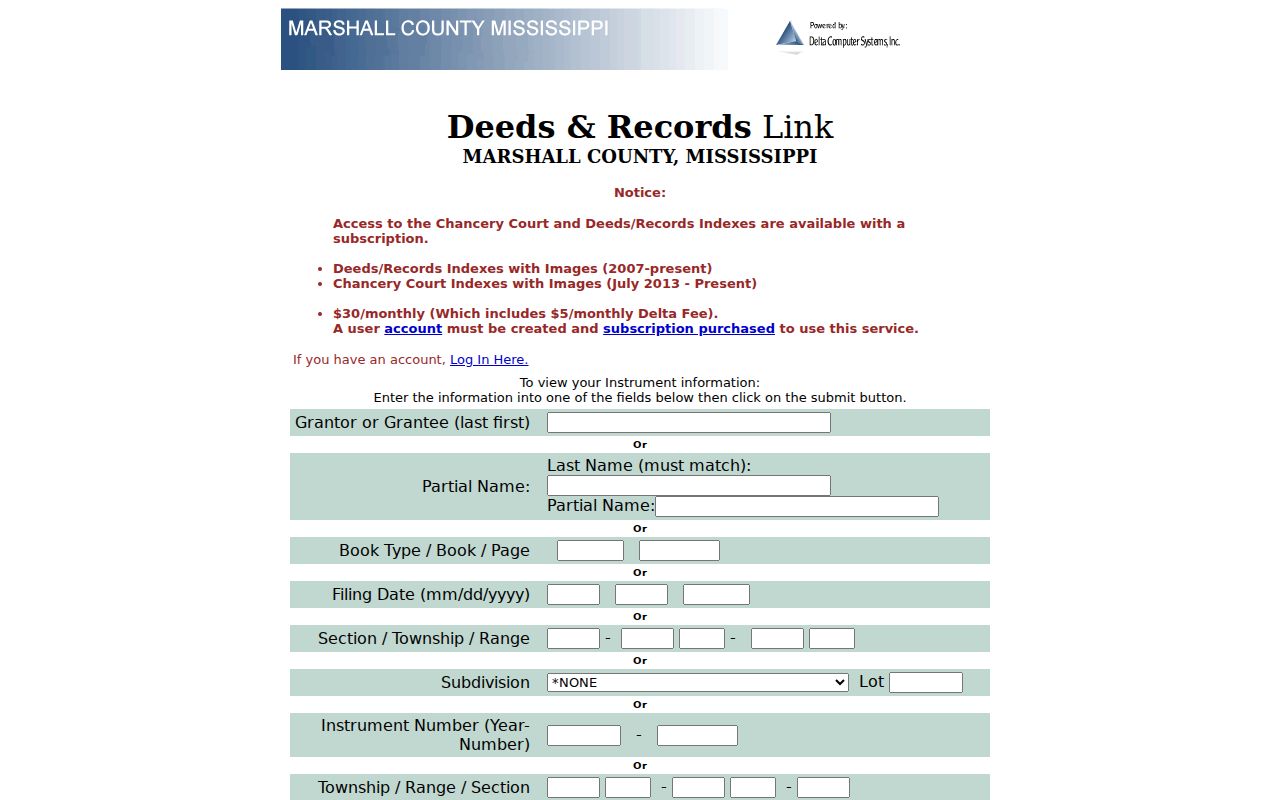
The form's fields keep the same parcel in view as names change. Book and page, filing date, section-township-range, subdivision and lot, and instrument number each anchor a search while ownership shifts.
Keep Marshall County Former Owners Tied to the Legal Description
A street address is a modern convenience, not the legal-index key. Carry the subdivision and lot, or the section, township and range, from one deed to the next. Instrument number and book and page are also strong anchors. This matters most where an old road name differs from today's situs address. Byhalia's Pigeon Roost Road became Church Street, and the Collierville-Chulahoma Road corresponds to Highway 309. When a former owner disappears from the expected index, search spelling variants and both road names. A postal place can also extend beyond town limits. So a ZIP alone never proves two historic descriptions are different property. Stick with the legal description.
Read Marshall County Former-Owner Deeds With Care
A deed result should identify the parties. It should also show the instrument type, recording date, and a land description or recording reference. The exact live result labels, and any consideration field, are best confirmed on the record image itself. Read the image and compare its land with the prior instrument. A warranty deed, quitclaim deed, estate deed, or trustee-related instrument may each describe a transfer differently. A mortgage or deed of trust is an encumbrance. That is not necessarily a change of former owners. Releases and lis pendens play their own roles. For the mechanics of one recorded copy, the Marshall County deed records guide covers the details. Keep this chain focused on ownership moving backward.
Reconstruct Marshall County Prior Owners Backward
Treat the current deed as the first row, not the end goal. Each deed supplies the name needed for the next search. Record every match in a timeline, because similar names, repeat transfers, and instruments touching another lot can pull the chain off course fast.
- Find the present owner's acquisition deed, with that owner shown as grantee.
- Copy the grantor, filing date, deed type, instrument or book/page and full legal description.
- Search that grantor as an earlier grantee and verify the same land identity.
- Repeat one transfer at a time, then shift to clerk-held books or microfilm before 2007.
- Grantor
- The party conveying an interest in the instrument.
- Grantee
- The party receiving the stated interest.
- Chain of title
- The ordered series of instruments linking prior owners to the present.
- Reverse index
- An index organized to locate grantees, used with the direct grantor index.
- Quitclaim and warranty deed
- Different forms of conveyance whose promises differ; both still require land and party verification.
Take Marshall County Former Owners Beyond 2007
The Chancery Clerk's online notice does not state full earlier index coverage. Contact Nicole M. Phelps's office at 662-252-4431 or P.O. Box 219, Holly Springs, MS 38635 with a known book and page, party range, and legal description. The office records instruments affecting land. The courthouse version is official. Ask whether the index or book you need sits at the counter, on a terminal, or comes as a supplied copy.
Online limit. The confirmed image span begins in 2007; earlier former owners require the clerk, deed books, finding aids or microfilm.
The Chancery Clerk does not publish exact copy fees online. Ask for a fee estimate before making a broad request rather than assuming a per-page cost.
Follow Marshall County Prior Owners Into the 1800s
MDAH's Marshall County Series 1202 offers a parallel path when deeds are hard to bridge. Its catalog lists combined records from 1836. It also lists land-tax groups from 1842, 1843, 1850, 1858, 1868, 1875, 1876, 1887, and 1889. More tax groupings run through 1896. Series 0355 adds groups from 1916 through 1932. Open the MDAH county-records finding aid to identify microfilm before a visit. The finding aid's county filtering route shows how those holdings are located.
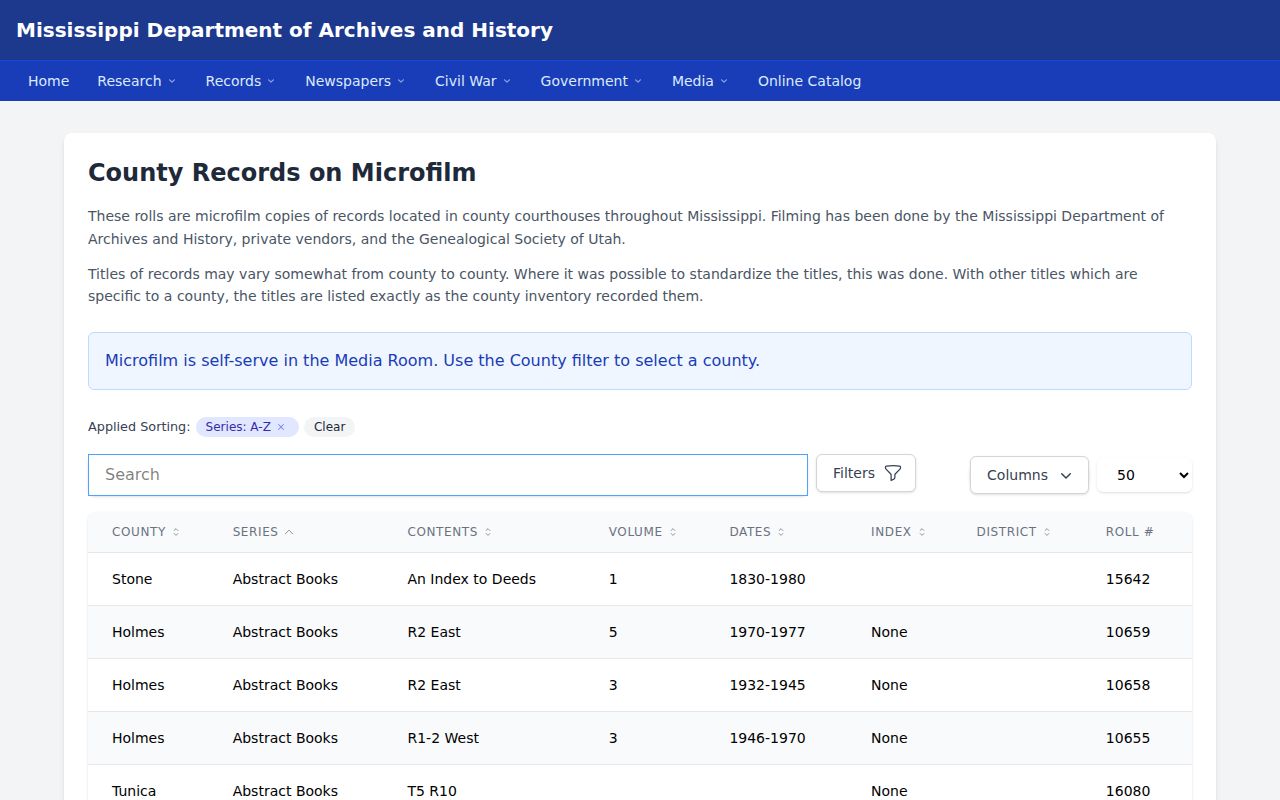
MDAH notes that county originals commonly stay at the courthouse while the archives keeps microfilm. Compare the archive notes with the clerk's holdings before planning either stop.
Account for Estate Transfers Among Marshall County Former Owners
Estate transfers can fracture an otherwise clean sale-to-sale chain of Marshall County property records. Land often moves through an estate, a guardianship, an heirship dispute, or a court order. This happens rather than through an ordinary sale. The Marshall County Chancery Clerk wears two hats. The office also serves as clerk of the Chancery Court. That court handles estates, conservatorships, guardianships, and property disputes. Start by searching each party in the deed index. Then ask whether a case file explains who had authority to convey the land. Kinship alone never puts an heir in the former-owner chain. The recorded deed, decree, or other controlling instrument must tie that person to the parcel. A plat reference can also help. It carries the work from a broad tract into later lots and blocks.
Place Marshall County Former Owners in Courthouse Context
Courthouse history shapes what a former-owner search can recover. Marshall County formed in 1836, and Holly Springs became the seat a year later. According to National Register history, Union troops burned the original courthouse. The replacement went up between 1870 and 1872. That fire is a real warning for deep research. Still, it does not prove any particular deed book was lost. Ask the clerk which volumes survived, which were recopied, and which exist on microfilm. FamilySearch's Mississippi State Archives collection spans 1818 to 1952. It includes land and tax records as published. Its span is no promise that every Marshall instrument is online. A careful former-owner timeline marks the gaps instead of filling them with guesses.
Judge How Far Marshall County Former-Owner Records Go
How far the records reach depends on the parcel and the surviving source. There is no single universal date. Online deed images have a clear starting point of 2007. Historic tax evidence reaches back to the county's formation era. Older deeds, plats, and court papers may require a trip to the clerk or an archives. Stop the chain where proof stops. Cite the recorder source for each transfer, and label any uncertain match as uncertain.
Lawful use. Research prior owners for property history, estate work and lawful diligence. Never use the record trail to track, harass or harm a living person.